
Conocimiento tradicional, agrobiometría y distribución espacial del maíz Mejen e híbridos en Jalapa, Tabasco México
DOI:
https://doi.org/10.66939/6htagt35Keywords:
caracterización biométrica, agrobiodiversidad, conservación in situ, recursos fitogenéticos, sistemas campesinos, Zea maysAbstract
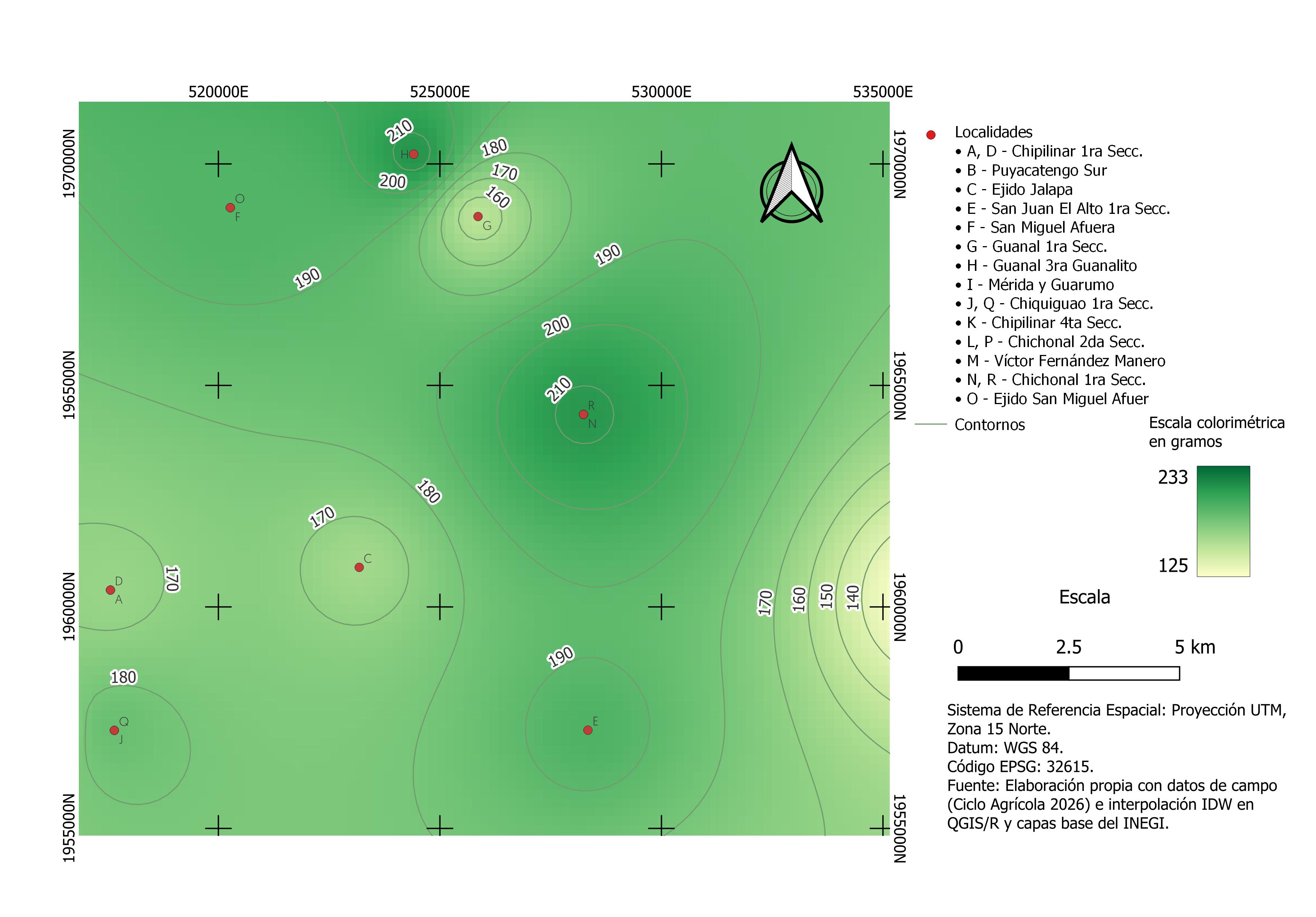
La conservación de los maíces criollos depende de su diversidad genética y del conocimiento tradicional asociado a su identificación y manejo. El objetivo de este estudio fue analizar la relación entre el conocimiento tradicional, las características agrobiométricas y la distribución espacial del maíz Mejen y materiales híbridos en comunidades de Jalapa, Tabasco, México. Se realizó un estudio observacional y transversal con la participación de agricultores experimentados pertenecientes a 18 Comunidades de Aprendizaje Campesino, quienes clasificaron mazorcas mediante criterios tradicionales basados principalmente en el grosor del raquis y la forma del grano. Posteriormente se evaluaron variables biométricas y componentes de rendimiento mediante análisis estadísticos y geoespaciales. Los resultados mostraron una asociación altamente significativa entre la clasificación tradicional y el grosor del raquis (p = 0.0001167), evidenciando concordancia entre ambos criterios. Asimismo, los híbridos presentaron mayor peso promedio de grano que el maíz Mejen (p = 0.0337), mientras que las demás variables no mostraron diferencias significativas. Los análisis espaciales no detectaron autocorrelación significativa. Se concluye que el conocimiento tradicional constituye una herramienta confiable para la diferenciación varietal y la conservación in situ del germoplasma local.
Downloads
References
Adikini, S., Kakeeto, R., Senabulya, S., Adriko, J., Okinong, D., Aita, A. M., Zaake, E., Ojulong, H. F., Odeny, D. A., & Kasule, F. (2026). Distribution, conservation, and indigenous knowledge of finger millet germplasm in different agroecologies in Uganda. Frontiers in Sustainable Food Systems, 9, 1716065. https://doi.org/10.3389/fsufs.2025.1716065
Alvarado-Beltrán, G., López-Sánchez, H., Santacruz-Varela, A., Muñoz-Orozco, A., Valadez-Moctezuma, E., Gutiérrez-Espinosa, M. A., López, P. A., Gil-Muñoz, A., Guerrero-Rodríguez, J., & Taboada-Gaytán, O. R. (2019). Morphological variability of native maize (Zea mays L.) of the West Highland of Puebla and East Highland of Tlaxcala, Mexico. Revista de la Facultad de Ciencias Agrarias UNCuyo, 51(1), 217-234. https://www.scielo.org.ar/scielo.php?script=sci_arttext&pid=S1853-86652019000200017&lng=es&nrm=iso
Álvarez-González, H. S., Santiago-Mejía, H., Tadeo-Robledo, M., Albino-Garduño, R., Pedraza-Mandujano, J., & Jonsson, M. M. E. (2025). Criterios campesinos y científicos para la caracterización de maíces nativos, Acambay, México. Agricultura, Sociedad y Desarrollo, 22(2), 262-277.
Atheequlla, G. A., Varte, Z., Lalrinfela, T., Mukherjee, A., Shubha, K., Balakrishna, B., Ramya, H. R., Kumar, H. V. H., Raju, R., Kumar, R. S., Das, L., Rakshit, S., & Roy, P. (2026). Conceptualizing indigenous seed storage as a climate-resilient food system infrastructure: Evidence from tribal community-based maize conservation in Eastern Himalaya. Frontiers in Sustainable Food Systems, 10, Article 1850667. https://doi.org/10.3389/fsufs.2026.1850667
Badu-Apraku, B., Fakorede, M. A., Nelimor, C., Osuman, A. S., Bonkoungou, T. O., Muhyideen, O., & Akinwale, R. O. (2025). Recent advances in breeding maize for drought, heat and combined heat and drought stress tolerance in Sub-Saharan Africa. Climate Change Reviews: 2022-2024, 223-255. https://doi.org/10.1079/cabireviews.2023.0011urlappend=%3Futm_source%3Dresearchgate.net%26utm_medium%3Darticle
Balconi, C., Galaretto, A., Malvar, R. A., Nicolas, S. D., Redaelli, R., Andjelkovic, V., Revilla, P., Bauland, C., Gouesnard, B., & Butrón, A. (2024). Genetic and phenotypic evaluation of European maize landraces as a tool for conservation and valorization of agrobiodiversity. Biology, 13(6). https://doi.org/10.3390/biology13060454
Caballero-Salinas, J. C., Guevara-Hernández, F., Pizaña-Vidal, H. A., Cadena-Iñiguez, P., Ovando-Salinas, J. E., & Gómez-Padilla, E. J. (2024). Morphological and agronomic evaluation of short-cycle native maize varieties (Zea mays L.). Agro Productividad, 17(10), 211-220. https://doi.org/10.32854/agrop.v17i10.3102
Caballero-Salinas, J. C., Pizaña-Vidal, H. A., Cruz-Ruiz, V. M., Fonteyne, S., & Vilchis-Ramos, R. (2026). Agronomic and economic analysis of native maize varieties grown with different fertilization rates under rainfed conditions in Chiapas, Mexico. Terra Latinoamericana, 44, e2389. https://doi.org/10.28940/terralatinoamericana.v44i.2389
Costa, F. M., de Almeida Silva, N. C., Vidal, R., Clement, C. R., & Veasey, E. A. (2023). A new methodological approach to detect microcenters and regions of maize genetic diversity in different areas of lowland South America. Economic Botany, 77(4), 345-371. https://doi.org/10.1007/s12231-023-09588-5
García-Cruz, L., Vázquez-Carrillo, M. G., Hernández-Galeno, C. D. Á., & Gómez-Montiel, N. O. (2026). Quality of Ancho maize populations from Guerrero, Mexico, for pozole-making. Agronomía Mesoamericana, 37, 63emb808. https://doi.org/10.15517/63emb808
Gaspar Génico, J. Á. (2026). Estadística aplicada a las ciencias ambientales y de la vida: una perspectiva computacional con Excel. Villahermosa, Tabasco, México. ISBN 978-970-96059-0-7. https://doi.org/10.66939/ameaia.estadisticaexcel.2026
Guzzon, F., Arandia-Ríos, L. W., Caviedes-Cepeda, G. M., Céspedes-Polo, M., Chávez-Cabrera, A., Muriel-Figueroa, J., Medina-Hoyos, A. E., Jara-Calvo, T. W., Molnar, T. L., & Narro-León, L. A. (2021). Conservation and use of Latin American maize diversity: Pillar of nutrition security and cultural heritage of humanity. Agronomy, 11(1), 172. https://doi.org/10.3390/agronomy11010172
Hammami, M. D. E., Kthiri, Z., Hamada, W., Malvar, R. A., Karmous, C., & Revilla, P. (2025). Genotypic variability of Tunisian maize landraces: A valuable genetic resource to mitigate drought and heat stress in the Mediterranean basin. PLOS ONE, 20(12), e0338577. https://doi.org/10.1371/journal.pone.0338577
Hammami, M. D. E., Malvar, R. A., Balconi, C., Mastrangelo, A. M., Mazzinelli, G., Redaelli, R., Torri, A., Troccoli, A., Kthiri, Z., Madur, D., Galaretto, A., Nicolas, S. D., Butrón, A., Charcosset, A., Hamada, W., Karmous, C., & Revilla, P. (2026). Genetic and environmental drivers of drought and heat stress adaptation in Mediterranean maize landraces. Journal of Agriculture and Food Research, 31, 103291. https://doi.org/10.1016/j.jafr.2026.103291
Kaufmann, M. P., Kubo, R. R., & Dal Soglio, F. K. (2026). Meshwork of agrobiodiversity: A South-Brazilian case study. Agroecology and Sustainable Food Systems, 50(1), 1-24. https://doi.org/10.1080/21683565.2026.2702615
López-Morales, F., Taboada-Gaytán, O. R., Gil-Muñoz, A., López, P. A., & Reyes-López, D. (2014). Morphological diversity of native maize in the humid tropics of Puebla, Mexico. Tropical and Subtropical Agroecosystems, 17(1), 19-31. http://dx.doi.org/10.56369/tsaes.1601
López-Valdivia, I., Rangarajan, H., Vallebueno-Estrada, M., & Lynch, J. P. (2026). Broad environmental adaptation is associated with root anatomical phenotypes in maize landraces: An in silico study. Annals of Botany, 138(2), 328-344. https://doi.org/10.1093/aob/mcaf179
Nanyangwe, S., Ndeve, A. D., Fato, P., Munisse, P., Oladiran, K. P., Lhamine, C. F., & Kipkoech, M. C. (2026). Phenotypic diversity in maize landraces: A systematic review of global patterns, methodological approaches, and implications for breeding. Genes, 17(4), 413. https://doi.org/10.3390/genes17040413
Oliva-García, D., Coutiño-Estrada, B., Rojas-Barrera, I. C., Perales, H., Piñero, D., Wegier, A., & Mastretta-Yanes, A. (2026). Diversity and genetic structure within a Mexican maize race reveal consistent biocultural processes across geographic scales. Genetic Resources and Crop Evolution, 73(1), 73-92. https://doi.org/10.1007/s10722-025-02682-8
Páez, M. V., & Astier, M. (2026). Reframing native maize conservation, the energy-gender nexus, and food sovereignty in rural Mexico. Elementa: Science of the Anthropocene, 14(1), 1-18. https://doi.org/10.1525/elementa.2025.00023
Park, J. S., Hong, S., Go, J., Seok, M.-G., Lee, H., & Yi, G. (2026). Tracing the global spread of maize (Zea mays L.) through plastome analysis of landraces. BMC Plant Biology, 26(1), 8. https://doi.org/10.1186/s12870-025-07829-4
Pizaña-Vidal, H. A., Caballero-Salinas, J. C., & González-Cabañas, A. A. (2025). Semillas nativas de maíz frente a los híbridos comerciales: Realidades contemporáneas de los Valles Centrales de Chiapas. En Bioeconomía en Latinoamérica: desafíos para la sostenibilidad y el desarrollo. Volumen 2. Sector primario (pp. 134-168). El Colegio de la Frontera Sur.
Prasanna, B. M. (2012). Diversity in global maize germplasm: Characterization and utilization. Journal of Biosciences, 37(5), 843-855. https://doi.org/10.1007/s12038-012-9227-1
Ramírez-Grande, E., Astier, M., Costich, D. E., & Camacho-Villa, C. T. (2026). Reviewing assumptions around the giant maize Jala landrace locally known as maíz de húmedo: The importance of local knowledge for the in situ conservation of agrobiodiversity. Genetic Resources and Crop Evolution, 73(4), 165-182. http://dx.doi.org/10.1007/s10722-026-02794-9
Rivera-Poulsen, C., Polzer, C., Hölker, A. C., Presterl, T., da Silva, S., Terán-Pineda, M., Ouzunova, M., Melchinger, A. E., & Schön, C.-C. (2026). Rapid cycling genomic selection in maize landraces: A step toward closing the yield gap. Theoretical and Applied Genetics, 139(1), 5. https://doi.org/10.1007/s00122-025-05107-3
Rojas-Barrera, I., Wegier, A., Sánchez, J., Owens, G., Rieseberg, L., & Piñero, D. (2019). Contemporary evolution of maize landraces and their wild relatives influenced by gene flow with modern maize varieties. Proceedings of the National Academy of Sciences of the United States of America, 116(42), 21302-21311. https://doi.org/10.1073/pnas.1817664116
Rosales, A., Burgueño, J., Gómez-Pérez, V., Molina, A., Cabrera-Soto, L., Chassaigne, A., & Palacios-Rojas, N. (2026). Unveiling the physical and nutritional profiling of grains in maize landraces and hybrids. Foods, 15(16), 2933. https://doi.org/10.3390/foods15162933
San Vicente-Tello, A., & Jonsson, M. (2019). Landrace maize diversity in milpa: A socio-ecological production landscape in Soteapan, Santa Marta Mountains, Veracruz, Mexico. En K. Takeuchi, S. Shiniti, N. Hartel, M. M. E. Jonsson, A. San Vicente-Tello, C. M. Beltrán, & P. Cruz-León (Eds.), Understanding the Multiple Values Associated with Sustainable Use in Socio-Ecological Production Landscapes and Seascapes (SEPLS) (pp. 73-84). United Nations University Institute for the Advanced Study of Sustainability.
Secretaría de Bienestar. (2026). Acuerdo por el que se emiten las Reglas de Operación del Programa Sembrando Vida para el ejercicio fiscal 2026. Gobierno de México. https://www.gob.mx/cms/uploads/attachment/file/1059943/ROPS_SV_2026_26-02-2026.pdf
Toribio-Solís, V. M., Moreno-Ramírez, Y. R., Santillán-Fernández, A., Chacón-Hernández, J. C., Neri-Ramírez, E., & Rocandio-Rodríguez, M. (2026). Morphological characterization and ecogeographic variation of maize landrace populations in a multialtitudinal transect of Tamaulipas, Mexico. Revista Fitotecnia Mexicana, 49(1), 25-34. https://doi.org/10.35196/rfm.2026.1.25
Vega-Alvarez, I., Santacruz-Varela, A., Rocandio-Rodríguez, M., Córdova-Téllez, L., López-Sánchez, H., Muñoz-Orozco, A., & Hernández-Bautista, A. (2017). Genetic diversity and structure of native maize races from Northwestern Mexico. Pesquisa Agropecuária Brasileira, 52, 1023-1032. https://doi.org/10.1590/S0100-204X2017001100008
Wei, L., Guo, L., Zhao, D., Guo, J., Jin, Y., Gao, J., Cui, H., Zhang, L., Liu, P., & Guo, Z. (2026). Phenotypic variation and diversity assessment in maize landraces. PLOS ONE, 21(8), e0355741. https://doi.org/10.1371/journal.pone.0355741
Downloads
Published
Data Availability Statement
El código fuente en lenguaje R utilizado para los análisis biométricos e inferenciales del manuscrito se encuentra integrado en el cuerpo del documento como material suplementario para garantizar su libre acceso y reproducibilidad.
Issue
Section
Categories
License
Copyright (c) 2026 José Ángel Gaspar-Genico, Jade Janice Soberano Orueta (Autor/a)

This work is licensed under a Creative Commons Attribution 4.0 International License.